
Account hierarchy
Key management and permissioning architecture
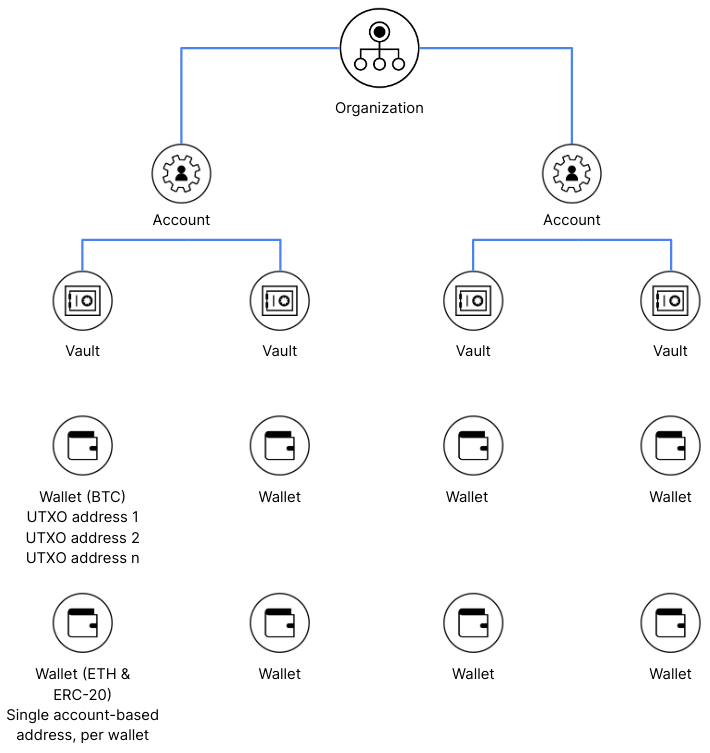
Anchorage Digital’s security model uses a hierarchical structure for organizational entities and crypto assets. Each level has unique properties, allowing for flexible configurations to meet your organization's needs. While all use cases are unique, each maintains consistent structural rules. The following diagram provides an overview of each:
Organizations
At Anchorage Digital, the organization is the highest hierarchical classification within the product, where a client or partner of Anchorage Digital is onboarded. Clients may have one or many accounts under each organization.
Accounts
Each organization can have multiple accounts. Each account can be its own legal entity, under the parent organization, or a part of the legal parent organization. This enables parent organizations to onboard separate business entities while maintaining separate ownership of assets at the account level.
Accounts can also be used to onboard end customers (program customers) under the control of the middle-B partner (partner platform) for B2B2B or B2B2C use cases. For more information, contact our client experience team at [email protected].
Vaults
Under each account, there may be one or many vaults. A vault is Anchorage Digital’s way of organizing asset wallets and user and API key permissions. If the organization has multiple vaults, each one can be managed by the same or separate admins on the account.
Each vault has its own security and quorum approval policy. Admins elect who manages each vault and how many vault members constitute a quorum for sensitive transactions or activities within the vault. Vaults can hold single or multiple assets, depending on the use case. Each vault also has its own vaultID which is used to request or filter API responses, including withdrawals, trades, and transfers.
VaultID: ThevaultIDis uniquely identifiable across the Anchorage Digital platform and can be used to reference a vault using Anchorage Digital’s APIs. You can find thevaultIDfield when hitting the list vaults endpoint.
Note: Only the vaults provisioned on the API key will be returned using the list vaults endpoint.
Wallets
Under each vault, there may be multiple wallets. A wallet at Anchorage Digital is similar to a traditional crypto wallet, with slight nuances to match the structure of Anchorage Digital’s platform capabilities and services.
Anchorage Digital wallets are tied to a particular blockchain and serve as a flexible way to aggregate and manage assets. This removes the complexity and need for users to manage multiple addresses, while maintaining the ability to trace assets and view separate on-chain interactions. There may also be multiple wallets on the same blockchain within the same vault, if needed to support the use case.
Wallet creation
All active members of a vault can create a wallet via the create wallet API, which does not require quorum approval. Wallet addresses can be reused, although they cannot be deleted once generated in a vault, as they remain live on the blockchain.
Note: If a vault is ever deleted, clients must ensure individuals—including counterparties—with access to wallet addresses refrain from sending additional assets to the deleted vault. If a deposit is made to an address under a deleted vault, Anchorage Digital can reactivate it to retrieve the assets.
Default wallet
If there are multiple wallets for the same blockchain within a single vault, the first wallet created for each specific blockchain will be designated as the default wallet. The following operations require the default wallet to be used, as these are all specified at the vault-level and therefore the default wallet will be the source of funds:
- External withdrawals
- Settlement of funds from Anchorage Digital trading into client vaults
- Execution of a hold via API
UTXO vs. account-based wallets
There are various types of asset wallet models used by Anchorage Digital: account-based and unspent transaction output (UTXO) wallets. The conceptual difference is that the account model updates user balances globally.
The UTXO model only records transaction receipts. In the UTXO model, account balances are calculated on the client-side by adding up the available unspent transaction outputs (UTXOs).
When a transaction uses more funds than needed from a source address, the remainder (or "change") is sent to a new change address within the wallet. These change addresses are automatically managed and are part of the wallet's balance.
| Type | Account-based wallets | UTXO wallets |
|---|---|---|
| Definition | Account-based wallets contain one address for multiple assets on the same blockchain. Its transaction model is similar to spending on an ATM card, where the balance is reduced by the exact amount a client spends. This method keeps track of the balance of each account as a global state. | UTXO wallets take into account the unspent transaction output, where a single input will result in a new unspent balance and a net-new address created within the wallet each time this occurs. This is similar to using a one dollar bill and getting change in return. |
| Example | An Ethereum-based wallet with a single address for ETH and ERC-20s (e.g. USDC). | A Bitcoin wallet with multiple addresses for the same BTC wallet, each with individual on-chain balances, but pooled together for transactions and transfers. |
| Additional notes | The address is used as the only deposit address across all tokens within the wallet (e.g. ETH and USDC). Asset-specific balances, transfers, and transactions on the wallet are all accessible in the iOS app, web dashboard, and on-chain using blockchain explorers. | During a transfer or transaction, funds are automatically pulled from multiple source addresses-users do not need to designate addresses on their end. All addresses created can be used as deposit addresses at Anchorage Digital. |
Balances
Each asset in an Anchorage Digital vault contains an availableBalance and a totalBalance:
availableBalance is the balance of funds that is available to be withdrawn, held, or transfer. This is the value that should be used when reading balances for client balance monitoring or evaluating sufficient client funds.
When a portion of the balance is being held or locked using our holds API, the availableBalance is the remaining portion of the totalBalance available to use. The portion held using Anchorage Digital’s holds API will be held until it is released, canceled, or a hold is executed or transferred.
totalBalance is the total amount of assets under custody within the vault, regardless of existing holds in place. This balance may contain funds that are held, in progress, or locked for activities like voting.
This balance will always be greater or equal to the availableBalance.
Updated 4 months ago